 Add to Chrome
 Add to Firefox
 Add to Edge
From paper to benchmark: agentic, framework-based reproduction of under-specified methods in machine health intelligence
May 27, 2026
Industrial Prognostics and Health Management (PHM) provides a representative case study for a broader challenge in applied machine learning: translating published papers into executable, benchmark-ready implementations. Reproducing under-specified methods in PHM is particularly difficult due to restricted access to industrial datasets, incomplete reporting of preprocessing and evaluation protocols, and implicit design choices (e.g., windowing, target construction, data splits) that critically affect performance. Existing paper-to-code systems generate implementations for individual papers, but these artifacts are often not directly comparable due to inconsistencies in assumptions and evaluation settings. We introduce \emph{agentic, framework-based PHM paper reproduction}, where an agent translates a paper into a shared PHM benchmark framework via a \emph{slot-binding interface}. This interface maps equations and protocol descriptions into structured components (task definitions, dataset adapters, windowing, targets, models, and evaluators), while explicitly recording unresolved assumptions. The resulting implementations are validated against standardized task contracts and evaluation hooks, enabling consistent and comparable benchmarking. We evaluate this approach on 16 PHM papers, comparing framework-enhanced, skill-based and prompt-based agentic reproduction against a recent framework-free paper-reproduction agent. We assess reproduction success, model-based code evaluation, framework binding of paper assumptions, and cross-paper benchmark comparability under standardized protocols. Our results show that coupling agentic generation with a shared framework transforms paper reproduction from isolated code synthesis into executable, assumption-aware, and systematically comparable benchmark implementations.

Picid: A Modular Evaluation Infrastructure for Reproducible PHM Across Tasks and Domains
May 27, 2026Progress in Prognostics and Health Management (PHM) is hindered by the lack of standardized and reusable evaluation practices across tasks, datasets, and application domains. Reported results are often difficult to reproduce and compare, as key protocol choices, such as data splits, preprocessing, label alignment, temporal windowing, and metrics, are often implicit or implemented ad hoc. We introduce \picid, a modular evaluation infrastructure that formalizes the PHM evaluation pipeline as an explicit, executable, and reproducible protocol. Through well-defined abstractions, \picid enforces deterministic, leakage-safe dataset construction while remaining flexible across diverse PHM settings. The framework supports fault detection, diagnostics, and prognostics through a unified interface and can be extended to new datasets and model classes without violating protocol invariants. By standardizing data contracts and evaluation boundaries, \picid also enables fair cross-task comparisons across diagnostics (classification) and prognostics (regression), allowing identical model families to be evaluated consistently across heterogeneous settings. We demonstrate \picid through an empirical evaluation of thirteen models on twelve datasets spanning batteries, bearings, turbofan engines, hydraulics, filtration systems, and buildings. This work establishes a reusable foundation for standardized, fair and reproducible evaluation in PHM.
Integrating Physics-Based and Data-Driven Approaches for Probabilistic Building Energy Modeling
Jul 23, 2025Building energy modeling is a key tool for optimizing the performance of building energy systems. Historically, a wide spectrum of methods has been explored -- ranging from conventional physics-based models to purely data-driven techniques. Recently, hybrid approaches that combine the strengths of both paradigms have gained attention. These include strategies such as learning surrogates for physics-based models, modeling residuals between simulated and observed data, fine-tuning surrogates with real-world measurements, using physics-based outputs as additional inputs for data-driven models, and integrating the physics-based output into the loss function the data-driven model. Despite this progress, two significant research gaps remain. First, most hybrid methods focus on deterministic modeling, often neglecting the inherent uncertainties caused by factors like weather fluctuations and occupant behavior. Second, there has been little systematic comparison within a probabilistic modeling framework. This study addresses these gaps by evaluating five representative hybrid approaches for probabilistic building energy modeling, focusing on quantile predictions of building thermodynamics in a real-world case study. Our results highlight two main findings. First, the performance of hybrid approaches varies across different building room types, but residual learning with a Feedforward Neural Network performs best on average. Notably, the residual approach is the only model that produces physically intuitive predictions when applied to out-of-distribution test data. Second, Quantile Conformal Prediction is an effective procedure for calibrating quantile predictions in case of indoor temperature modeling.
Benchmarks and Custom Package for Electrical Load Forecasting
Jul 14, 2023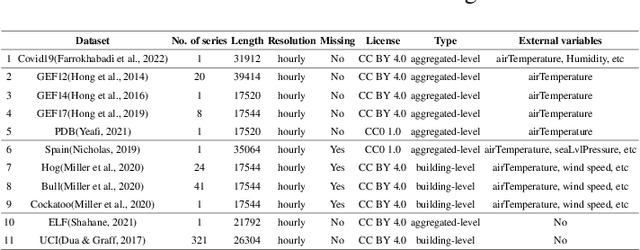
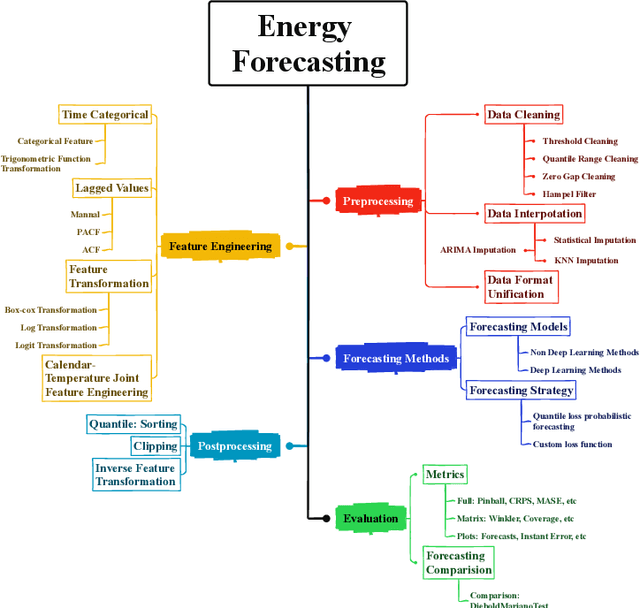
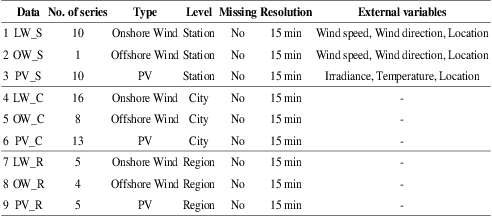
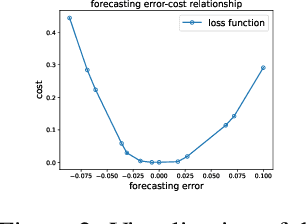
Load forecasting is of great significance in the power industry as it can provide a reference for subsequent tasks such as power grid dispatch, thus bringing huge economic benefits. However, there are many differences between load forecasting and traditional time series forecasting. On the one hand, load forecasting aims to minimize the cost of subsequent tasks such as power grid dispatch, rather than simply pursuing prediction accuracy. On the other hand, the load is largely influenced by many external factors, such as temperature or calendar variables. In addition, the scale of predictions (such as building-level loads and aggregated-level loads) can also significantly impact the predicted results. In this paper, we provide a comprehensive load forecasting archive, which includes load domain-specific feature engineering to help forecasting models better model load data. In addition, different from the traditional loss function which only aims for accuracy, we also provide a method to customize the loss function based on the forecasting error, integrating it into our forecasting framework. Based on this, we conducted extensive experiments on load data at different levels, providing a reference for researchers to compare different load forecasting models.